
Security implementation / Rust
ELFGuard
Offline ELF64 hardening analysis
I built a zero-dependency Rust analyzer for ELF program headers and dynamic linking metadata. It finds executable-stack declarations, writable/executable load segments, PIE evidence and partial/full RELRO without loading or executing the binary.
What I was trying to prove
I wanted hardening reviews to explain the exact evidence behind a finding. A claim like 'PIE enabled' means little if the parser quietly confuses shared libraries with position-independent executables or reads past a malformed header.
Untrusted local ELF → offline Rust parser. This tool reads metadata; it never loads the ELF.
- 01 · Input
ELF64 bytes
Untrusted file / ≤64 MiB CLI cap
- 02 · Boundary
Checked parser
Header bounds, offsets, lengths
- 03 · Analysis
Program + dynamic headers
PT_LOAD · GNU_STACK · RELRO · BIND_NOW
- 04 · Output
Evidence report
PIE / NX / W^X / RELRO, including unknown
Failure path: Malformed, overflowed or unsupported ELF → explicit error, never execute, and never report missing evidence as safe.
Enforcement: Range checks and format validation enforce parser safety; findings describe metadata rather than exploitability.
Architecture of the implemented reference system, not a production deployment diagram.
Implementation decisions
- Implemented bounded little-endian ELF64 parsing with checked offsets, checked arithmetic and explicit rejection for unsupported formats.
- Extracted PT_GNU_STACK, PT_LOAD, PT_INTERP, PT_GNU_RELRO and PT_DYNAMIC, then evaluated dynamic tags for eager binding before reporting RELRO strength.
- Kept unknown states explicit: a missing GNU_STACK entry does not certify that the stack is non-executable, and ET_DYN alone does not establish an executable is PIE.
- Added structured fixtures for executable-stack and RWX segments, full/partial RELRO, non-PIE, unknown metadata and malformed binary ranges.
Adversarial paths and trust boundaries
- Untrusted binary metadata may be truncated, maliciously oversized or internally inconsistent. Parser behavior must be bounded and must not panic.
- Writable and executable mappings weaken code/data separation. The tool flags mapping metadata but does not infer an exploitable primitive.
- RELRO claims require both a GNU_RELRO segment and eager binding; otherwise lazy relocation entries may remain writable.
Test evidence
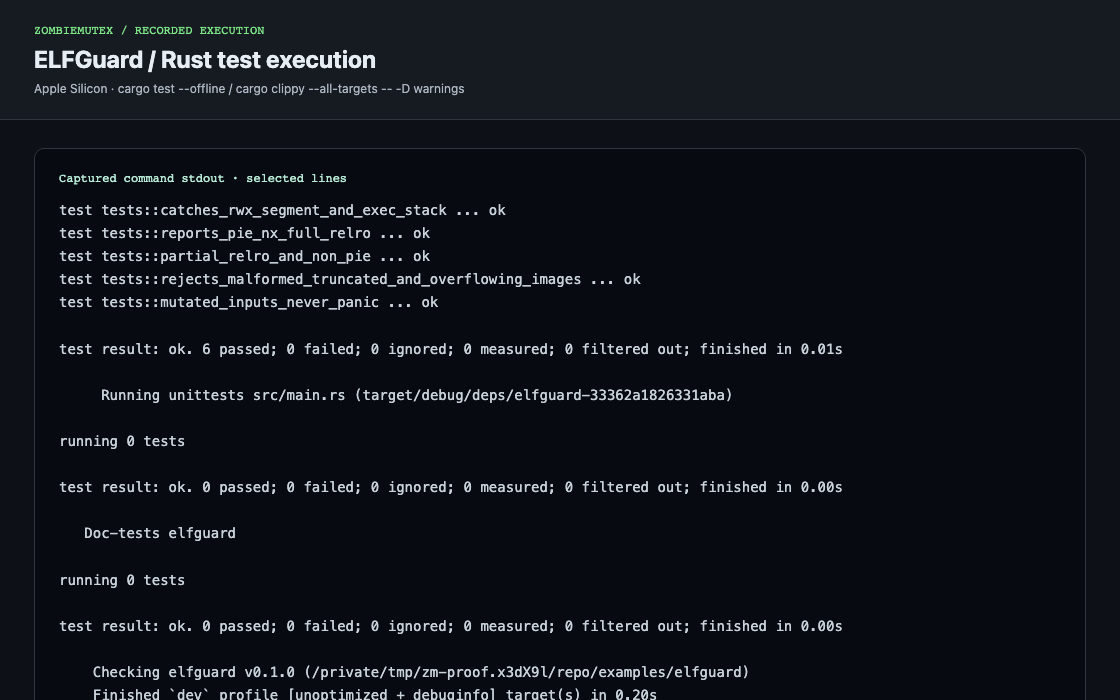
- cargo test --offline: 6/6 library tests passed on Apple Silicon, including 10,000 deterministic mutated ELF inputs without parser panic.
- cargo clippy --offline --all-targets -- -D warnings: passed.
- Input is never executed and the tool performs no network operations.
Reproduce locally
cd examples/elfguard
cargo test --offline
cargo clippy --offline --all-targets -- -D warnings
cargo run --release -- /path/to/authorized/elf
Run against fixtures or binaries you own or are authorized to inspect. The complete working project remains in my private site repository; the published downloads provide reviewable source and tests, not a public GitHub repository.
What I am not claiming
- ELF64 little-endian only. No Mach-O or PE parsing.
- Does not certify a stack canary, host ASLR, CET, BTI, PAC or exploitability.
- Static metadata analysis, not a loader or an executable sandbox.