
Project notebook / Audio ML
ImplementedAudio ML Training, Evaluation & Ablations
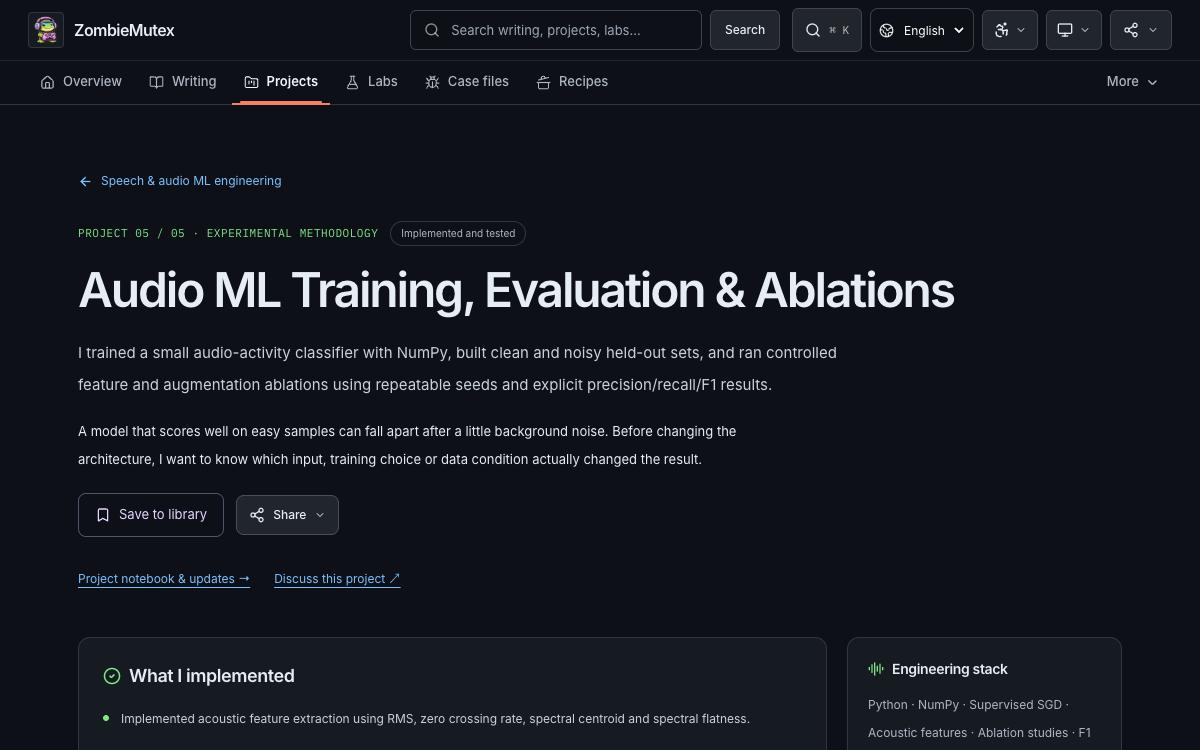
I trained a small audio-activity classifier with NumPy, built clean and noisy held-out sets, and ran controlled feature and augmentation ablations using repeatable seeds and explicit precision/recall/F1 results.
What I built
- Implemented acoustic feature extraction using RMS, zero crossing rate, spectral centroid and spectral flatness.
- Trained a logistic speech-activity classifier with standardized inputs, gradient descent and regularization.
- Ran RMS-only, multi-feature and noise-augmented experiments on fixed synthetic holdouts, recording confusion counts, precision, recall and F1.
Experiments & checks
- In the seeded synthetic noisy holdout, the clean-trained multi-feature model scored F1 0.361, while the noise-augmented model scored F1 0.867; the RMS-only baseline scored F1 0.689. These are outcomes on generated waveforms only, not general speech benchmarks. The large drop before augmentation is precisely why controlled evaluation is useful.
Notes & limitations
A model that scores well on easy samples can fall apart after a little background noise. Before changing the architecture, I want to know which input, training choice or data condition actually changed the result.
This trains a real small classifier, not a foundation ASR/TTS model, self-supervised encoder, or multi-GPU system. The synthetic dataset does not establish performance on accents, languages, devices or real speech recordings.
I like a good hypothesis. I like it even more when the next experiment proves it wrong before anything reaches production.
Screenshots & media
Project updates
Dated notes tied to actual revisions of the site, not a simulated activity feed.
Audio experiments published
Added five implemented audio-ML projects with local experiments and measurement limits.
Site revision 8d75d02
These entries reflect published changes to this website. The website repository is private; revision IDs are not public source links.
Discuss this project
Questions, ideas, minimal reproductions and corrections are welcome. Each project has its own public GitHub Discussion.
You can read without an account; posting requires GitHub sign-in. Keep private customer information, credentials and restricted material out of public threads.
Open this project's discussion