
Project notebook / Audio ML
ImplementedSpeech-to-Text Robustness & ASR Evaluation
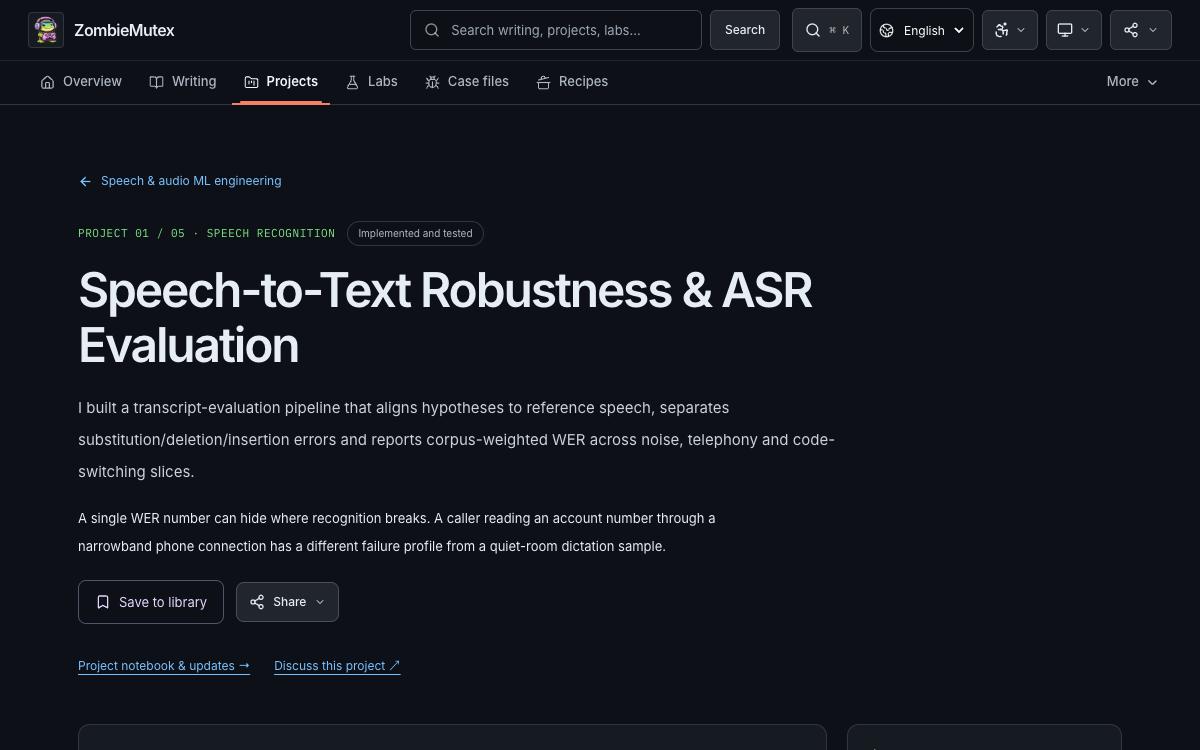
I built a transcript-evaluation pipeline that aligns hypotheses to reference speech, separates substitution/deletion/insertion errors and reports corpus-weighted WER across noise, telephony and code-switching slices.
What I built
- Implemented Unicode-normalized word and character error rates with dynamic-programming edit alignment.
- Built slice-aware corpus aggregation with separate error counts for clean, noisy, telephony and code-switching examples.
- Built a JSONL evaluation CLI and deterministic test fixtures, so an actual recognizer adapter can be compared without changing the scoring contract.
Experiments & checks
- The included four-pair illustrative corpus scores 4 word errors across 27 reference words (WER 14.8%). Those hypotheses are authored fixtures, not output from a trained recognizer. The scoring algorithm is implemented and unit tested; plugging in an ASR model is a separate integration.
Notes & limitations
A single WER number can hide where recognition breaks. A caller reading an account number through a narrowband phone connection has a different failure profile from a quiet-room dictation sample.
This implementation evaluates transcripts; it does not train, fine-tune or serve an ASR model. Actual accent, noise, code-switching and language performance require representative labeled recordings and speaker-separated test sets.
A model can understand the sentence and still get the account number wrong. The database tends to care about the number.
Screenshots & media
Project updates
Dated notes tied to actual revisions of the site, not a simulated activity feed.
Audio experiments published
Added five implemented audio-ML projects with local experiments and measurement limits.
Site revision 8d75d02
These entries reflect published changes to this website. The website repository is private; revision IDs are not public source links.
Discuss this project
Questions, ideas, minimal reproductions and corrections are welcome. Each project has its own public GitHub Discussion.
You can read without an account; posting requires GitHub sign-in. Keep private customer information, credentials and restricted material out of public threads.
Open this project's discussion